


Arts Rescue Mission -Aid For Aging Artists

P u b l i s h e d W e e k l y, N e w s, A r t s, & S t o r i e s F r o m T e x a s .... U s u a l l y


Vol. 2, No. 4, p. 1
May 5, 2026
How The Houston Underground Survived to Become History. Notsuoh at 30 Years. Pirtle, Topchy, Hixon, and Lowe Remember.(some) of Their Journey
d. m. allison, The Mission News, May 23, 2026
(word count 5,569 - image 68)
Everything has a beginning and a source, a circumstance, an environment, a chain of events linking back to earlier roots. History is a thread made from these connections. I have often told people that Collision, Gershon’s book, starts with “God made sand and man made the Alamo,” then somehow winds its way all the way to the Fire Show and James Surls.
So, I pulled that thread, and this article ended up becoming much longer than I expected. A LOT LONGER. I never learn….
Every city has things that occur culturally during its formative years. If you ever drove around Dallas before GPS and wondered who in the hell designed the highway system, the answer might very well be cows. The old trails from ranches to rail yards and slaughterhouses eventually hardened into roads, then highways. Those early patterns echoed forward through time whether anyone planned them or not.
More recently, Dallas organized its own art fair and, frankly, one reason Dallas succeeded is that it treated the fair itself as an institution-building mechanism rather than simply a rentable convention product. Houston’s fairs have too often felt temporary, almost parachuted in from somewhere else, instead of emerging organically from Houston’s own cultural DNA.
Dallas has long been collector-based. Houston, by contrast, has always been artist-based. A great deal of that cultural DNA was incubated in the mid-1980s around Commerce Street Warehouse, where factions formed, splintered, and evolved into organizations and movements that would permanently shape the city’s creative identity — DiverseWorks, the Art Car movement, The Orange Show, and eventually one of Houston’s most original and enduring cultural landmarks: notsuoH at 314 Main Street.
For more than three decades, Jim Pirtle has transformed notsuoH into one of Houston’s most extraordinary living works of art — a labyrinth of memory, friendship, performance, improvisation, and creative endurance.
The performance art they were doing first at the Commerce Street warehouse, Zocalo, and then notsuoH, is in the tradition of classic Dada. I looked it up just to make sure. Emerging in Zurich during World War I, Dada rejected conventional ideas of art and embraced absurdity, improvisation, found objects, and a healthy distrust of polite society. Artists such as Marcel Duchamp transformed ordinary objects into works of art, while others used performance, satire, and public spectacle to blur the boundary between everyday life and artistic expression. In much the same spirit, the Commerce Street artists turned cast-off materials, outrageous costumes, modified automobiles, and even their own public behavior into creative acts. Their art was irreverent, collaborative, and often hilariously resourceful, proving that imagination can flourish even when money is scarce. (1.)
To start the story, I was invited recently to join a group organized by Richard Tomcala that has been meeting on Thursdays at La Tapatia to plan a photography exhibition commemorating America’s 250th anniversary. Knowing several of the participants from my years around the Station Museum of Contemporary Art, nicknamed the “Garage Mahal,” including former assistant director Alicia Duplan, Richard Tomcala, Ken Walkins, and Daniel Jircik, I suspected it might turn out to be less a celebration than a protest, and the discussion around the lunch table would prove me right.
After we settled in around what soon became a crowded table, one of the last people through the door arrived pushing a wheelchair occupied by a much older gentleman. It was not until halfway through lunch that I realized the man seated at the end of the table, wearing a camel-hair sport coat, white shirt, and slacks, dressed like any real-estate broker or urban businessman, was Jim Pirtle. I hardly recognized him out of context.
Then I remembered that Jim had recently posted on Facebook about fixing breakfast for his father, the very gentleman seated beside him, now ninety-five years old.
Our mutual friend Deborah Grotefeldt had been delighted in 2022 when she thought she spotted Jim hitchhiking down I-10 with a group of mannequins as some sort of roadside art performance. I saw it too. He fooled both of us. What he was actually doing was stopping at various locations with four mannequins, dressing them up on the roadside, putting on one of his vintage dresses, and taking photographs.
The episode harkens back to the early days at the Commerce Street Artists Warehouse. After moving out of a corner of Nestor Topchy’s studio into his own space, Jim began painting directly on polyester shirts, tags and all, at Nestor’s suggestion. He found the bright 1970s spandex colors irresistible and soon started wearing the shirts to gallery openings attended by the core Commerce Street group. Eventually the shirts gave way to the wacky dresses that became one of his signatures.
“It got to be normal,” Jim recalled. “Everyone just expected I’d be wearing a dress. When I didn’t, everyone would ask me what was wrong.”
Another ritual developed among the Commerce Street regulars, Jim Pirtle, Rick Lowe, Nestor Topchy, Mariana Lemesoff, Dan Havel, Sharon Wilcutts, and possibly James Bettison, also known as Betty Jamison, would head out for the evening in Nestor’s “chop-shop chariot.” And of course, George Hixson was around for almost all of it, camera usually nearby. Somebody had to document the chaos. Otherwise, half these stories would sound completely made up. Not just another participant. The archivist. Hixon was the visual memory system of the entire tribe.
“We didn’t have any money,” Jim said, “so we’d all pile into the ’72 Mercury Marquis station wagon. Topchy had cut the top off for easy entry, since he had welded the doors shut during one of the car’s many modifications. We’d go foraging at gallery openings for the free wine, and then to some of our usual haunts, sometimes if they got fancy, Bill Sadler’s Café Noche, more usually semi-dives like Shanghai Reds, where we could load up on free hors d’oeuvres if we paid for a glass of wine.”
They were gaming the system in the way only starving artists can. It must have been tremendous fun, and wouldn’t you have loved to run into the Commerce Street gang out on a Saturday night? Sadly, this was just after my own time hanging out at Bill’s Noche.
I can see the lineage now, from the crucible of creative madness that unfolded in the rear performance area of Commerce Street to later works such as The Art Guys walking the length of Little York Road in 2013. The Art Guys understood that publicity was not separate from art; it was part of the medium. They used newspapers, television, billboards, and public spectacles as materials in much the same way another artist might use paint or bronze.
Everyone at Commerce Street seemed to be collaborating with everyone else in the late 1980s, though some partnerships became especially enduring. Jack Massing and Michael Galbreth formalized and named their collaboration almost immediately in the mid-1980s, becoming one of Houston’s best-known artistic duos. Nestor Topchy and Jim Pirtle collaborated constantly and often spontaneously, while Rick Lowe and Topchy remained roommates for years after the warehouse days.
Pirtle and Topchy as well as artists Lowe, Massing and Galbreth, were creating original cultural content in much the same way that James Harithas helped shape the identity of the Contemporary Arts Museum Houston, the way James and Ann Harithas helped launch the Art Car movement, and the way Marilyn Oshman recognized something extraordinary in produce hauler Jeff McKissack during the late 1970s. It is one thing to step into the role of director at a major museum in Houston, Dallas, or Fort Worth; it is another thing entirely to recognize the cultural moment you are living in and build something from scratch. That was Houston. The 1980s were the Wild West.
The various groups eventually splintered from the early Commerce Street Warehouse days surrounding Jim Pirtle, Nestor Topchy, and George Hixson. Striking out on their own, Jack Massing and Michael Galbreth created The Art Guys, artists performing without a net, so to speak, and without the protection of a permanent institution behind them. Of all the people I have mentioned, I would say Jack Massing has consistently had a creative hand in helping others ever since I have known him.
By the late 2000s and early 2010s, Jack seemed instinctively to understand what I was trying to do at Nau-haus on 11th Street, and later at D. M. Allison Gallery on Colquitt. He brought over flat files that became furniture for our main gallery space, and he organized memorable projects with groups such as Negativland, the American experimental music collective founded in the San Francisco Bay Area during the late 1970s by Mark Hosler, David Wills, Peter Conheim, and Jon Leidecker.
Their photo essay Death Sentences was absolutely staggering. The group entered automobiles involved in fatal accidents and documented the contents left behind inside the glove compartments, trunks, and seat cushions: notes, receipts, photographs, fragments of ordinary life that suddenly became haunting evidence of a final day. The black-and-white photographs, combined with scans of the recovered objects, transformed twisted wreckage into deeply human narratives.
Wow.
Somehow Jack also knew I had a bass guitar and could use a few extra dollars. He bought the bass for his stepson, along with a bicycle equipped with a headlamp that I had originally purchased for riding around the Heights after Hurricane Ike knocked out Houston’s electricity in 2008 for weeks. The neighborhoods turned almost communal during that time: people gathered on porches for improvised cookouts, Coleman stoves appeared in front yards, and families sat outside late into the night because of the heat and the lack of ice.
Seeing Jack now helping lead what I consider one of Houston’s most important cultural institutions, and watching it move confidently into a second generation after Marilyn Oshman, is nothing short of remarkable. Jack’s ability to collaborate has never been in question. Today, twenty-seven boxes of Art Guys ephemera reside within University of Houston Special Collections under the care of Christian Kelleher.
From afar, when the torch passed to Jack and Pete Gershon joined him, I suspected another important Houston collaboration was forming. Later, when Cody Ledvina came aboard as archivist for The Orange Show Center for Visionary Art, the possibilities seemed enormous. They were. They are. The three horsemen of Houston’s creative cavalry arrived quietly, but they are likely to remain a major force in the city’s cultural life for years to come.
Now back to my narrative. As we left the restaurant, I shook Jim’s father’s hand and told Jim that we needed to get together and talk about Deborah and her husband, Virgil Grotefeldt, and the Houston art scene of the 1980s and 1990s. Deborah, a great admirer of Jim’s madcap approach to art, would certainly have enjoyed the reunion.
At that moment I had no idea that May would mark the thirtieth anniversary of Notsuoh, nor how completely astonished I would be during my first visit to Jim’s menagerie in more than twenty years. I did not yet know how extraordinary the place had become, or how dramatically the city had grown up around it over the last three decades.
Virgil Grotefeldt, a house painter by trade, had once hired both Jim and Nestor to help him with jobs. As Jim remembered it, Virgil taught them an important lesson that stayed with them long after the paint had dried. Several artists including Michael Galbreth would remark later, “He really taught us a lot, you never forgot how to clean a brush.” (2.)
So when I heard that Jim was hosting a series of events beginning on Wednesday the 6th, with additional programs planned for Thursday, Friday, and Saturday, I decided to arrive early on opening night in hopes of catching him for a few quiet moments before he became too busy to reminisce.
I drove down Travis Street to the only public parking lot near notsuoH, paid the now-standard $19 parking fee, and as soon as I stepped away from my car I was struck by how much Houston had changed around Market Square Park since I was last a regular at La Carafe in the early-1980s.
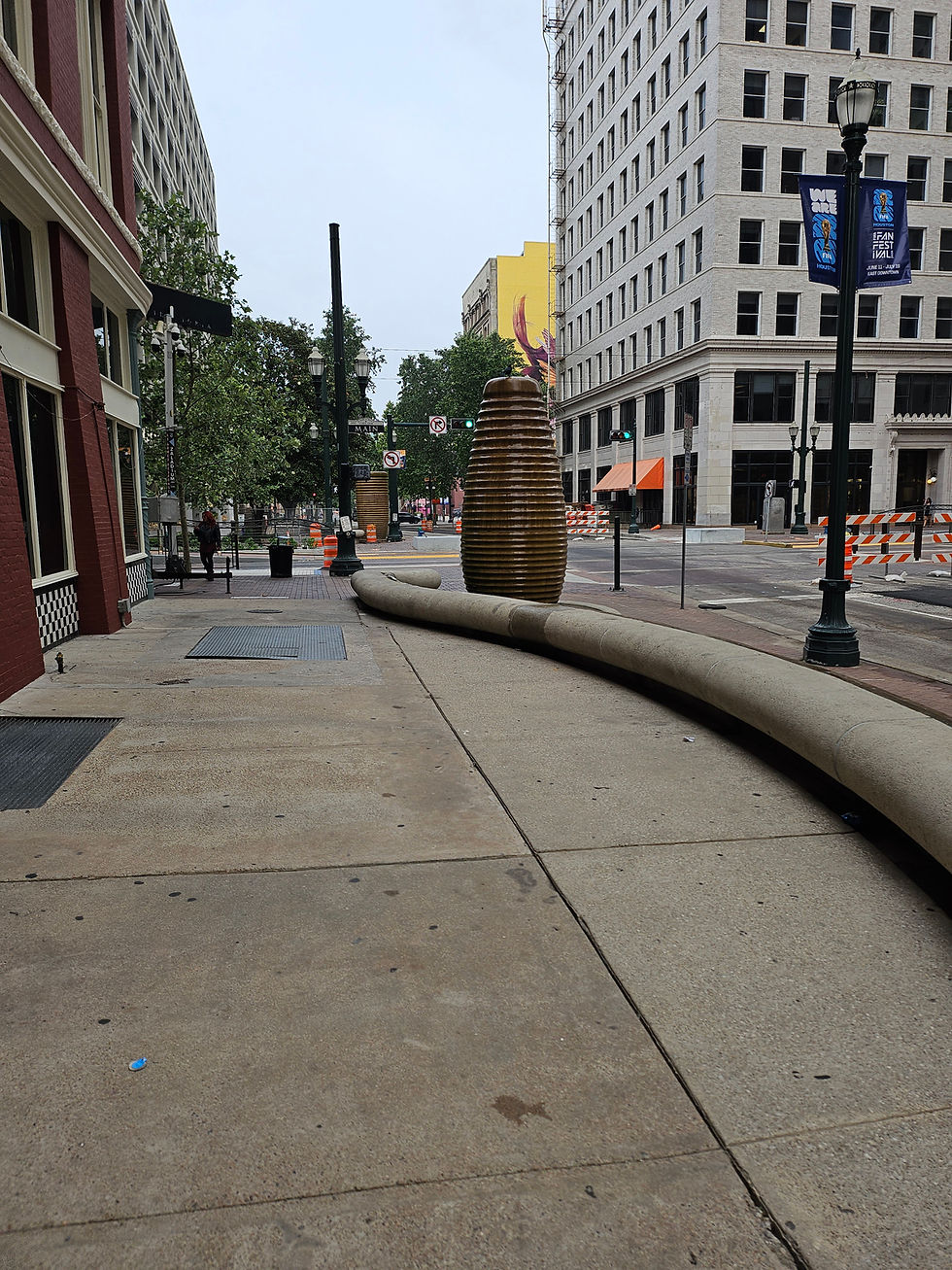
I am not sure what affected me more in that moment. As I walked along the serpentine water feature on Preston Avenue and turned the corner onto Main Street, I found myself staring at a world I had once known intimately, now completely transformed. The half-empty buildings, rough bars, and slightly dangerous charm of downtown Houston had been urbanized, landscaped, and carefully choreographed into something far more civilized.
Much of that transformation began with the arrival of the METRO-Rail Red Line in 2004. The original 7.5-mile starter line connected downtown to the Texas Medical Center and what is now NRG Stadium. The construction years could not have been easy for businesses along Main Street, including Jim Pirtle’s improbable kingdom. Yet Notsuoh endured.
Today the district resembles a carefully maintained Disneyland for grownups. You can even bring the kids. Standing there on Main Street, I was about to enter its most eccentric headquarters.
Passing beneath the red arbor at the entrance, I realized that visitors do not simply walk into notsuoH. They cross a threshold into a deliberately improvised environment where sculpture, taxidermy, painting, music, and conversation merge into what Jim has aptly called a “social sculpture.”
I paused to photograph a vaguely unsettling Twilight Zone child mannequin in the front window, part of an installation by Heather L. Johnson. Inside, a large woman in what might best be described as a New Orleans-style costume greeted me with a clipboard. For a moment I feared there might be a cover charge, an alarming possibility given that I had already surrendered nineteen dollars to the parking gods.
She asked whether I wanted to sign in. “Not really,” I said. “I’m looking for Jim Pirtle. Is he around?” “I saw him earlier,” she said, “but not in the last hour or so. He could be upstairs.”
He was not upstairs. He was standing directly behind me.
I turned, and I am certain we were both thinking the same thing. “Is that you?”
Except for a brief handshake at lunch a couple of weeks earlier, we had not really seen one another in more than twenty years.
After an enthusiastic guy hug, we walked with our arms over each other’s shoulders like two soldiers returning from an unnamed war. Jim led me to the back of the first floor where the main bar is located. Although bartenders were tending to guests and preparations for the evening were well underway, he devoted more than an hour to guiding me through the labyrinth he has been constructing for the past three decades.
Progress at Notsuoh occurs at a pace entirely different from the outside world. “Do you want something to drink? Beer? Water?”
“Water would be great.” “Perrier good for you?” “Sure.”
Jim circled behind the bar, looked in the upright cooler, then searched beneath the counter. His bartender said, “We don’t have any Perrier.”
“We don’t have any?” Jim, incredulous, but patient. “How about a Topo Chico?”
“Perfect.”
“You sure have a lot of moving parts around here,” I said.
Jim smiled as he watched me undergo what can only be described as a gob smacked moment of realization over the scale of what he had accomplished. He motioned for me to follow him toward the front of the building. Jim walked ahead and I trailed behind. About fifteen minutes later we had covered perhaps sixty feet. Progress was slow because every few steps he stopped to point out another artwork or tell another story.
Along the way we passed pieces by Dan Havel, Sharon Wilcutts, Nestor Topchy, and Rick Lowe, along with a taxidermied baboon and ostrich, mannequins, and countless fragments of Houston’s artistic history assembled into a living collage. Nothing seemed accidental, yet nothing felt entirely planned. The effect was less like a designed interior than an organism growing according to its own eccentric logic.
Jim paused before a series of softly blurry, erotic photographs by Dan Havel and Sharon Wilcutts, made from partially damaged sheets of oversized photographic paper they had discovered in an abandoned building, perhaps even in notsuoH itself during the first night Jim received the keys, before he had officially signed the lease in 1996.
According to several accounts, when Jim and his friends first entered the former Clark’s House of Easy Credit, it appeared as if someone had simply stood up and walked away. Cigarette butts still rested in ashtrays. Merchandise remained on shelves. Upstairs, offices and storerooms were filled with abandoned objects: musical instruments, a saxophone, a sousaphone, snow skis, and hundreds of boxes of unworn 1970s platform shoes. It was another genuine Twilight Zone moment. Rod Serling covered a lot of ground. Everyone associated with the business seemed to have vanished.
So, Poof. Instant art performance.
As George Hixson later recalled, after the initial astonishment and hilarity subsided, the group went back downstairs and reenacted their own entry into the building as if they were staging a break-in. I think George might have the pictures somewhere. Hope he finds them. Hixon among other things was the group’s photographer, and documenter for all occasions. They sure needed him. If a tree falls in the forest ...... George would snare the image.
Nestor Topchy: “George was the guy that photographed everything, looked like Bruce Willis and was always ready
to blow something up.” George recalled in our interview of one such occasion.
"We all piled in the Nesters car and went to HPD's supply depot. As we went in and before anyone could stop him Jim Pirtle walked up to the counter and asked for some black powder, then offered, "We're going to make a bomb" and of course we got thrown right out the door. "We ended up at Carter Country, you know the gun supply on Katy Freeway, and this time Nestor did the talking and did not elaborate about what the black powder was for.
So we got back to Commerce Street, and I filled a paper bag with the black powder, a nichrome wire detonator and we put that inside a balloon full of paint. We put that balloon with the bag of gunpowder inside another balloon of paint, and put that inside yet another balloon of paint, and left it by the toilet with a wire leading out of the building and around the corner where we were crouching down beneath the window of the bathroom. You know three, two, one, kablooey!
It blew the window out of the building. It was a lot bigger bomb than we thought. We went back in, and the toilet was completely destroyed, bathroom completely decorated with smoldering paint, burning embers floating in the air and little fires all over the walls; water spewing from what was left of the commode." (4.)
"Did you get a picture of that?"
"Yeah"
"I bet everybody in the building was pretty happy with you guys, and no toilet"
"Nah, they were fine, in fact we left it way for at least a week.” Hixon added, “Do you remember Jim in diapers?"
“Sort of, but I never saw the performances in person”
Hixson went on to recall a couple more stories in Houston and New York about Jim Pirtle in diapers, baby bonnet, baby carriage, eating mayonnaise until he hurled. I know I heard about it back in the day. That's the kind of story, before there was social media, which overcame a lack of technology and wires. You just heard about it, that's it.
James Bettison dressed as Betty Jameson, I suppose here as the mommy, in full drag, with Pirtle in diapers performed both at Houston's legendary Record Exchange one evening and then again when Nestor arranged performances at New York's Pace University. Topchy costumed as the human flea and Pirtle's singing brat were the finale. Jim sang in his bonnet, and ate mayonnaise, smearing it all over his face until he regurgitated. Pace security had enough and the whole lot of them were escorted off campus. Well, after all it was the finale.
As our tour continued into the late afternoon, Jim pointed out an early circular cutout by Nestor Topchy that foreshadowed the spherical forms he would later exhibit at Hiram Butler Gallery. On the north wall hung an early painting by Rick Lowe from a particularly dark series addressing slavery and lynching.
Jim smiled at the contrast.
“Rick was doing these paintings based on slavery and lynching,” he said, “ya know, and then he’d pop out of the studio all smiles. Cheerful by nature, you know how he is, always bright and funny.”
Rick Lowe is another artist who helped create original cultural content specific to Houston itself. From everything I have read and heard over the years, Rick was both independent and quietly influential during the early Commerce Street Warehouse period before going on to co-found Project Row Houses. Like The Art Guys, this was not simply an exhibition program or a borrowed institutional model imported from New York or Los Angeles. It was something rooted directly in Houston’s neighborhoods, history, labor, and social reality. It gave the city a particular cultural character that could not easily exist anywhere else.
I became more involved with Rick while exhibiting the work of Jesse Lott at my gallery on Colquitt. At the time, crews were still tearing apart the interior of the building and hanging sheetrock while we prepared the space. Rick and Jesse walked in during the middle of the construction. Rick looked over at Jesse and joked, “Pick something up, Jesse, make it look like you’re working.” I happened to have my camera in hand and snapped several photographs right then and there.
(68 images Click On Image To Expand To Full Screen)


For more than three decades, Jim Pirtle has transformed notsuoH into one of Houston’s most extraordinary living works of art, a labyrinth of memory, friendship, performance, improvisation, and creative endurance. The performance art they were doing first at the Commerce Street warehouse, Zocalo, and then notsuoH, is in the tradition of classic Dada. I looked it up just to make sure.
The funny thing was that Rick actually did start working. Almost instinctively, he picked up a taping spatula and a mud tray and began floating one of the walls as though he had been on the job site all morning. That came from the old days. Rick, Nestor Topchy, and sometimes even Jim Pirtle had all worked under the older Houston artist Virgil Grotfeldt, where they learned practical trades alongside art making: how to clean brushes properly, tape a wall, float sheetrock, and build things with their hands. Back in the early 1980s we used to call Virgil “Slick.” He was so good at finishing drywall that he barely needed to sand afterward.
That work ethic carried over into Houston’s art culture itself. These artists were not operating from polished institutions or large budgets. They built spaces, repaired walls, hauled lumber, improvised exhibitions, and created communities almost simultaneously. In hindsight, that mixture of physical labor, collaboration, improvisation, and imagination may be one of the defining characteristics of Houston’s alternative art scene during that era.
In my interview with Lowe he filled me more details about their wine, and food runs on Thursday and Friday nights at the establishments that George Hixson would see in the local paper. Hixson was working at a local paper and would have the necessary gallery and restaurant listings with free food and hors d'oeuvres getting customers in on Thursday and Friday nights.
By this point the pieces were beginning to fall into place. notsuoH was not simply a bar or an eccentric
environment.
It was a map of relationships stretching back to the Commerce Street Artists Warehouse of the late 1980s, where many of these artists were developing their voices long before they became central figures in Houston’s cultural history.
As we sat down outside and joined other people sitting at the café tables I recounted a story of returning home from some exhibition in Japan or California, I don’t remember, but all in all pretty full of myself, setting out from my new bungalow on 14th St. near Studewood. I was in the mood to celebrate a little, heading east on Washington avenue towards La Carafe when this car with the top chopped off went airborne in front of me close enough for me to recognize Nestor Topchy at the wheel, head and left arm out of the car to catch some dangerous night air, right arm stretched back to reach the wheel, and Rick Lowe sitting dangerously on the seat and back of the flying car pointing forward, apparently navigating. Nestor told me later Rick was the navigator. Of course he was. They were running the pylons underneath the freeway at enough speed to become airborne momentarily across the avenue.
My thought then as it is now, I wish I could have been in the car with them. I had become the old establishment guy. I had money by my own hand, a new house, a new car, and signing autographs a thousand miles from home. They were a generation younger living life to its fullest if it didn’t kill them. I really wanted to be in that car so I could do it all again. In interviewing Jim, Nestor, and George for this piece, I got the feeling they too thought of this time in their lives as their best years. So, this was the one time I caught their act live.
My mind wandered back to the moment with Jim. Our conversation turned to some politics and also using AI to help do our taxes, probably a lot like our dads would talk about how they were doing their taxes with that new fangled computer thing back in the day. Pirtle was proud to mention that his daughter Martha was taking over Dean's House of Credit Clothing next door starting this month and they just gotten through signing the papers to make the end of this block a family business.
"I'm going to challenge you" Jim was being courteous and realizing I was having problems with my balance after getting really sick the week before, but I was game, and he was going to lead me on a tour. Remember, he has all kinds of people pouring into his place and he was kind enough to take the time to give me the Royal guided tour. So back inside we went and up the stairs to the second floor, stopping momentarily on the first floor to appreciate a young buxom woman having her chest painted, a stuffed giraffe, some more works by contemporary artists Earl Staley, and Mary Hayslip and a Statue of David.
Up the stairs we went, passing by a more intimate, rough-hewn bar in an enclave. All I could remember from the good old days was that there was a selection of some hundreds of shoes on the second floor and that used to be an outstanding feature there but not now. The shoes were there, but most memorably three rooms, one was a domed room that amplified one's voice about 10 fold with a German artists experimenting with films in the round. Jim pulled me close in the center of the room, "Say Something," he grinned. "Something" Woah! God like authority suddenly reverberated around us. "Mary had a little lamb," boomed and mingled with the 3D video projected on us and the curved walls of the dome designed to not only amplify sound, but to project video in an unbroken horizon of reality. It was working.
Another room, full blown recording studio going on, more stuffed animals along the way. Maybe Jim had stumbled at some point on to a taxidermist that was going out of business. (during Covid Jim got some extra money, Hixon, and Topchy both found taxidermied animals for Jim’s menagerie)
Jim led me through a doorway onto a small brick-walled patio and pointed out one of notsuoH’s most personal features: a striking 16-by-18-foot mural commissioned as a tribute to his dear friend Michael Galbreth, with whom he played chess in this very courtyard for more than twenty-one years. The mural, painted by Houston artists Mel Eason and August Lewis of Joy Brush Signs, was conceived by Jim Pirtle as one artist’s homage to another. The surrounding walls are adorned with Viking shields created by Houston sculptor Dean Ruck, adding to the courtyard’s theatrical atmosphere. Painted in bold red, black, and white, the mural is organized like a giant playing card. At its center, two mannequin hands reach toward one another in a gesture reminiscent of Michelangelo’s The Creation of Adam, but instead of exchanging life, they pass chess pieces, an elegant metaphor for friendship, strategy, and the quiet rituals that shape both our lives and the Houston art community around them.
Then Jim led me up to the third floor by way of a spiral staircase in a glass enclosure created by artist Dean Scranton. Here's where our story comes full circle to the lunch at La Tapatia, the exhibition they were planning that afternoon is going to be in the room billed as the notsuoH white walled Gallery room. "Take a look. This is the gallery where we can have, you know, like regular shows, like a gallery with lighting and everything" uh yeah. The room had a dozen chairs gathering in matching groups of dissimilarity, a Queen Anne couch, several other pieces of furniture along with a stuffed full sized Spanish Toro Bravo. This is the room that the “American 250” exhibition will premiere June 4th, and open June 6th featuring photographers and installation artists Richard Tomcala, George Hixon, Ken Walkins, Daniel Jircik and others.
Pirtle seems to be in collaboration with his building, featuring, supporting, promoting, artists and talent as they come in the door. The building itself has become his partner not unlike Gilbert and George, or The Art Guys, collaboration itself could become an artistic medium and that the artists’ public identities could be integral to the artwork. In this case Jim created an alternative identity for the House of Easy Credit and has been bouncing ideas off the old structure for 30 years.
For anyone interested in Houston’s art and cultural history, this block is sacred ground. Long before Houston became an international city, this square was where farmers, merchants, politicians, and ordinary citizens gathered. It remains one of the few places downtown where the layers of Houston’s past are still palpable.
Originally called Congress Square on the 1836 plan laid out by surveyors Gail Borden Jr. and Moses Lapham, the block was intended to house the capital of the Republic of Texas. That never happened, and the site instead evolved into Houston’s commercial and civic heart. For nearly a century it housed successive market buildings and city halls before becoming the public park we know today. (4.)
Jim disappeared to go get an extension cord or some such thing while I sat on the Queen Anne couch with Robert Boyd, discussing various ailments and new medicine recent miracle cures, actor Jeremy Renner and his miraculous recovery from running over himself with his own snow plow during a family gathering for the holidays. Our optimistic conclusion was that we might be the first generation that could live, if not forever quite a bit longer than our parents -- if someone doesn't blow up the world first.
I found Jim sitting at a table and the only area of the building that is sort of free and clear of objects on the third floor. I have not experienced it but I believe this is the performance area.
I sat down to say goodbye and thanked him for the wonderful tour during such a busy moment and the kickoff of his 4-day celebration of 30 years at his location at 314 Main Street. No sooner than I sat down than someone reminding me of Houston arts matron Jackie Harris, or Susan Venus both active characters back in the day as well as now presented Jim with a celebration Rice Krispies and marshmallow Duchamp style urinal which was starting to sag and drip on the floor.
With all the patience in the world Jim got up and gave this woman a big hug and thanked her for the wonderful gift before sprinting off to get something to clean up the mess. When he returned and the place was starting to crowd-up with visitors, a bevy of women started lining up to kiss Jim congratulations, coming up to the third floor by the dozens. Pirtle rolled his eyes just enough to say goodbye.
notsuoH is more than a bar, gallery, or performance space. It is the enduring monument to a generation of artists who understood that art was not something confined to a frame or placed on a pedestal. It was a way of inhabiting the world, with humor, audacity, and enough imagination to turn an old downtown building into one of Houston’s most extraordinary works of art.
(1.) Dada: Art and Anti-Art,1964, artist and filmmaker Hans Richter (2.) Nestor Topchy interview, May 8, 2026, 9 p.m.
(3.) George Hixon interview, May 16, 2026, 1 p.m.
(4.) Rick Lowe interview, May 18, 6 p.m.
(5.) Jim Pirtle meeting and photos May 6, 6:30 PM, and phone interview May 15, 2026
“Meet Artist Nestor Topchy, the Mad Genius Hidden in Houston Heights,” By Molly Glentzer - August 8, 2023, and interviews with George Hickson, Nestor Topchy, And Jim Pirtle.
Last week’s 30th Anniversary fest kicked off with a market by Mithic Media, whose events have become a new Notsuoh favorite over the past year. Photography by RARA