


Arts Rescue Mission -Aid For Aging Artists


Vol. 2 No. 13, 09-03-2026\
p. 2 of 3
P u b l i s h e d W e e k l y, N e w s, A r t s, & S t o r i e s F r o m T e x a s .... U s u a l l y
Bernard Lifshutz's idea, James Lifshutz's inheritance
What Carolina Was Talking Aboutz
Carolina’s observation that the character of Blue Star has survived because of the people directing it, sent me looking into exactly how this place came to be.
It turns out that what looks today like something that grew organically over decades pretty much did.
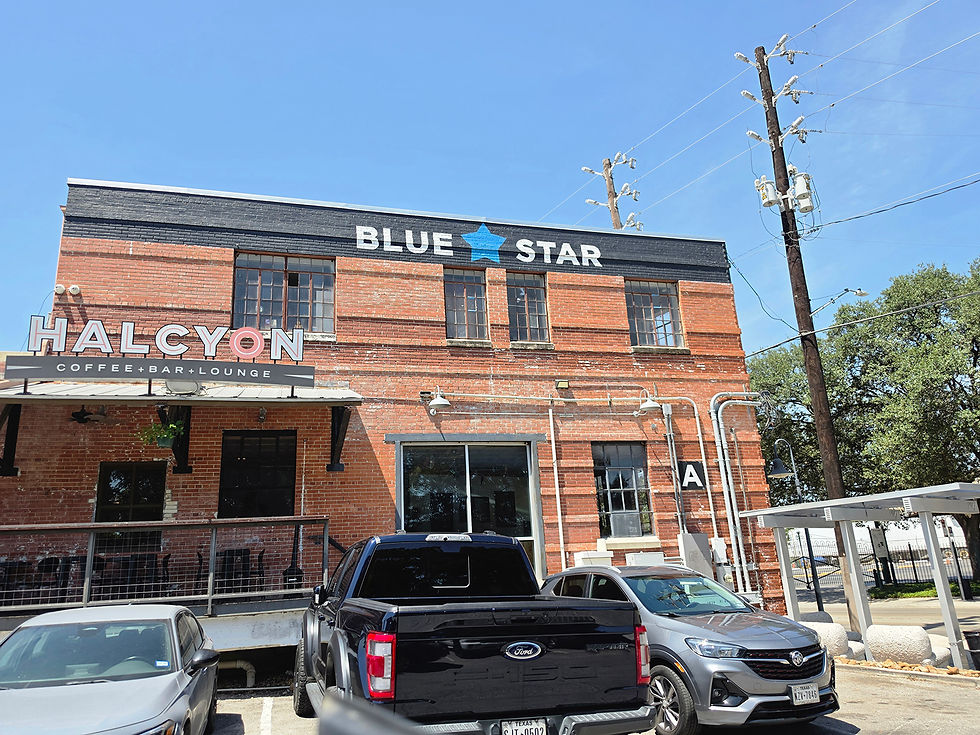
Long before anyone was drinking coffee, looking at paintings or living in a loft here, the property was industrial. The Blue Star Street Industrial Historic District contains four surviving warehouses built between 1917 and 1934 beside railroad tracks once owned by the San Antonio Belt and Terminal Railway Company. Produce dealers, chemical companies, cold-storage operations and other industrial tenants moved through the buildings over the years. Blue Star Ice and Cold Storage was one of them, and eventually its name stuck. The complex was placed on the National Register of Historic Places in 1994.
The transformation began in 1985, when San Antonio developers Arthur “Hap” Veltman and Bernard Lifshutz bought the largely vacant and deteriorating industrial property. Their idea was unusual for San Antonio at the time: instead of clearing the old buildings, they envisioned a mixed-use community of lofts, galleries, studios and working spaces for artists and designers.
Then something happened that probably changed the course of contemporary art in San Antonio.
In 1986, the San Antonio Museum of Art cancelled a much-anticipated exhibition of contemporary San Antonio artists. The artists suddenly had a show and nowhere to put it.
Veltman and Lifshutz gave them warehouse space.
Artists and volunteers went to work on what was described as a dusty, pretty awful industrial space, removing partitions, painting walls white, installing track lighting and turning a warehouse into a gallery. They apparently managed everything except air conditioning. More than 20 local artists participated in that first exhibition, and thousands of people came.
That temporary solution became permanent.
On June 27, 1986, Blue Star opened, and the grassroots organization that grew from that exhibition became what is now Contemporary at Blue Star, San Antonio's first and longest-running nonprofit contemporary art space. The original organization, Contemporary Art for San Antonio, was founded by Richard Mogas, Jeffrey Moore, Kent Rush, Adair Sutherland, Lewis Tarver and Richard Thompson. The success of that first exhibition also helped give birth to what became Contemporary Art Month.
Within two years, the warehouses were already becoming a genuine arts community. More than two dozen artists had studios or living quarters there, alongside galleries, architects, theater groups, a conservation operation and an experimental multimedia space.
Bernard Lifshutz's idea, James Lifshutz's inheritance.
This is where Carolina's comment about the place having someone's “soul” becomes particularly interesting.
Bernard Lifshutz helped create the original experiment with Hap Veltman. His son James Lifshutz inherited much more than the real estate.
James has said that he grew up in a household with “an aesthetic that honored old things.” After studying industrial engineering at the University of Wisconsin and earning an MBA at the University of Texas, he joined the family real-estate business. Blue Star, conceived by his father and Veltman, became his first major project.
And it nearly failed.
Financing was difficult. James later recalled that they came close to abandoning the project before securing a federal rehabilitation loan. That allowed them to build the residential lofts. The lofts generated income, and that revenue helped make the rest of the experiment economically possible.
That may be the most important thing to understand about Blue Star. It wasn't preservation by freezing a collection of old warehouses in time. It was preservation by finding something useful for them to do.
Artists could make work here. Galleries could show it. People could live here. Restaurants could feed them. Businesses could pay rent. The old buildings could survive because the buildings had an economy.
James Lifshutz has described Blue Star as the project that gave him both an expertise in and an affection for historic preservation and adaptive reuse. The San Antonio Conservation Society later honored him with its Texas Preservation Hero Award.
The philosophy didn't stop at Blue Star. At Hot Wells, another decaying San Antonio landmark, Lifshutz bought the ruined former resort property in 1999. Rather than erase the ruins, he eventually proposed preserving them as ruins. He donated the historic bathhouse and four acres to Bexar County; the county stabilized the structure and opened the Hot Wells historical park in 2019. Lifshutz subsequently created an interpretive center next door.
So, the peeling brick, industrial windows, strange passageways and mismatched collection of spaces at Blue Star aren't simply a developer's attempt to make a new project look old.
They are old. And somebody made the decision not to make them disappear.
The ecosystem that grew around the art:
Forty years after that first improvised exhibition, Contemporary at Blue Star remains the anchor. In 2026 the nonprofit is celebrating its 40th anniversary and continues to operate four galleries, presenting more than a dozen exhibitions a year along with education programs, artist opportunities and public projects.
But Blue Star isn't one big art institution. That's part of what makes walking through it confusing and interesting. Behind one door may be a museum exhibition, behind another a commercial gallery, and behind another an artist actually making something.
Some occupants have developed histories almost as long as Blue Star itself. San Angel Folk Art, founded by Richard Henry “Hank” Lee in 1989, has become an extraordinary repository of folk, outsider, visionary and vernacular art from Mexico, Latin America, the United States and beyond.
FL!GHT Gallery, run by artist Justin Parr, is a different animal, an artist's art space with a long history of giving artists room to experiment. It began in the Blue Star orbit, spent years elsewhere in Southtown, and eventually came back. Parr remains its owner and director.
There are also the Upstairs Studios, which the complex describes simply and rather wonderfully as “artist-run since 1986,” along with newer artist-run spaces including Et Hus, Un Grito Gallery, Tethered Art Studio, Print Matrix Space, Modern Eclipse Gallery, Carbon Bloom & Paper Room, and a growing collection of individual working studios.
And then there is everything that isn't strictly an art gallery.
Blue Star Brewing Company arrived in 1996. Founded by Joey Villarreal, it became San Antonio's first brewpub and is now itself approaching three decades as part of the complex.
Today the mix includes Halcyon, Stella Public House, Sukeban, Joe Blue's, King William Wine Co., an arthouse movie theater in Slab Cinema, shops, studios and the Blue Star Bike Shop. The official directory currently lists substantially more art spaces than restaurants, something worth noting when people dismiss today's Blue Star as having become primarily an entertainment district.
(18 images Click On Image To Expand To Full Screen)


That may be the most important thing to understand about Blue Star. It wasn't preservation by freezing a collection of old warehouses in time. It was preservation by finding something useful for them to do.
Artists could make work here. Galleries could show it. People could live here. Restaurants could feed them. Businesses could pay rent. The old buildings could survive because the buildings had an economy.
Years ago, James Lifshutz explained the mixture in terms that still seem to describe the place. His goal, he said, was to keep Blue Star the geographical nucleus of San Antonio's contemporary arts community, but artists and the people who come to see them also need places to eat, drink and shop.
Walking around Blue Star forty years after a bunch of artists cleaned out a dirty warehouse because a museum cancelled their show, that relationship between art and commerce is still being negotiated.
Maybe that's why the place feels alive. It isn't a preserved historical object. It's a preserved historical argument about what a city ought to do with its old buildings, and whether artists can be part of the answer.
Preservation is rarely a clean story.
Places like Blue Star survive because somebody figures out how to make them economically viable. Studios need tenants. Buildings need roofs, plumbing and air conditioning. Restaurants and bars bring people onto the property who might never have walked into a gallery otherwise. Apartments, shops and events create the revenue that keeps old industrial buildings from becoming either ruins or parking lots.
But success changes a place.
The more desirable a district becomes, the more valuable the property becomes. Rents rise. Restaurants multiply. Visitors arrive who may be more interested in dinner and drinks than what is hanging on the walls. Eventually the artists who helped make a neighborhood interesting can begin wondering whether they still belong in the neighborhood they helped create.
Blue Star has lived with that tension for years, and there is no particularly tidy answer to it.
Walking through the complex today, there is certainly plenty of commerce. There are restaurants, apartments, shops, wine, beer and entertainment. But there are also painters with brushes on tables, clay waiting to be worked, small galleries with doors open, exhibitions being installed, and people like Carolina Flores quietly occupying more and more of a room because there is artwork to make.
Perhaps the more interesting question isn't whether Blue Star has become too commercial.
It is how long a place can continue balancing the two things that have allowed it to survive in the first place: the artists who give it its identity and the commerce that helps pay for the buildings they occupy.
For the moment, both are still here. What happens next is probably the more interesting story.
SOURCES:
Why Southtown’s Blue Star is on the National Register of Historic Places, Timothy Fanning, Capitol Bureau news producer, Updated Jan 27, 2023
Blue Star began with modest exhibit, Collaborations, exhibits fill its artistic schedule, By Elda Silva, Staff Writer, San Antonio Express, Updated Sep 6, 2015
Blue Star Contemporary Announces New Name, Graphic Identity, and Website, Daniela Oliver Marketing + Communications, San Antonio, Texas on September 30, 2022
Blue Star Art Space: A Hub for Contemporary Art in San Antonio, Kendall Curlee, Texas State Historical Association
French culture among developer's passions, Festival spearheaded by James Lifshutz will offer film, food, music and much more. Michelle Koidin Jaffee, MYSA, Feb 20, 2011
Camp Hot Wells website: https://www.camphotwells.com/about-4
The Contemporary’s 40th Birthday Party! Contemporary website, Saturday, June 27, 2026
Blue Star Brewing Celebrates 25 Years of Cold Beer, Scratch Grub, and a Good Time, Jeremy Banas, True Brew America, Posted on May 12, 2021
It’s First Friday and Art is Alive and Well at Blue Star, Tami Kegley, San Antonio Report, May 2, 2014