


Arts Rescue Mission -Aid For Aging Artists


Vol. 2 No. 13, 09-03-2026\
p. 3 of 3
P u b l i s h e d W e e k l y, N e w s, A r t s, & S t o r i e s F r o m T e x a s .... U s u a l l y
Tim Olson at Blue Star Arts Center
Tim Olson's at Rosemary's Las Meninas, Art Space at Blue Star, Sept. 3, 2026
I called one of my favorite friends and artists Tim Olson when I knew I was going to be in San Antonio and asked if I could meet him at his studio. As it turned out his studio was at the Blue Star Art Center. Tanned, robust and vibrant I asked Tim, "Is my car parked in the right spot" "Yeah that's fine" "Where are you parked?" "Right here" as he pointed to the bike rack in front of Blue Star.
As we walked in, and as luck would have it, we were in for some unexpected drama. Paramedics were rushed by us. Someone had a stroke just outside the door of Tim’s studio which is located in a very prime location. He’s been on a waiting list for some years. There was a woman in a beautiful floral dress standing by the paramedics. Tim motioned to her and as soon as we got through with all of the what the heck is going on excitements, he introduced me to Carolina Flores. "She's been here longer than anybody" "She's somebody you should interview for sure she knows everything about the place, about Blue Star"
And Then There’s Tim Olson
All of this talk about preservation, development and whether Blue Star can remain an artists’ community eventually comes down to something much simpler.
I've known him for a good while now, maybe 10 years. He came through Houston looking for a gallery and then I saw his work I knew it was perfect for my gallery at the time on Colquitt. Poetic, narrative, found objects, unknown, and consistent, Tim had it all and we got him established with his first show. Sally Rynolds put him in a show at One and Two Houston Center as well.
After I closed the gallery, we lost track as I did with many of the artists who had shown with me. That was a great loss. From time to time, I saw Tim posting his same Consistently intimate drawings and colleges on Facebook. I felt a change and saw something good had happened for him in his personal situation since I first met him. He was living with his ex-wife and her twin sister, and a house painter lingering around named John Lennon. He's always somehow taken everything with good humor; the ups and the downs but now has a space at Blue Star, a decent housing situation, doesn't have a car, doesn’t need one, doesn’t want one. He’s a happy artist. He’s earned it.
After the initial commotion earlier in the story and an introduction to Carolina Flores I noticed in the hall outside of Tim's studio there were several installations of artwork, I assumed were there from last month’s events at Blue Star like First Friday, and First Thursday, and I think there's another event where loads of people the descend on the facility.
Getting to Tim Olson’s space is part of the experience. Outside are the old brick walls, steel railings, concrete walkways and mature trees that make Blue Star feel as if somebody worked very hard at not making it look new. Along the hallways, art begins before you actually reach anybody’s gallery. Little exhibitions and installations seem to appear wherever someone has found a wall, a corner or enough room to hang something.
Then you step into Tim’s place. It isn’t large. That may be part of why I like it so much.
There is no attempt to overwhelm you with architecture. White walls, concrete floors, track lights, a worktable, a bicycle, boxes, papers, tools, books and all the accumulated debris necessary for somebody who actually makes things.
Carolina Flores came up from our interview when I stopped in, Tim had cleared and repainted the larger walls. They were almost startlingly empty, waiting for the next First Friday exhibition.
But his work hadn't disappeared. It had simply retreated toward his desk.
And there, almost surrounding the place where he works, were dozens of intimate little Olson constructions: drawings, photographs, scraps of old paper, pieces of wood, found objects, tiny boxes and inexplicable things rescued from wherever Tim finds inexplicable things. Some are barely larger than your hand. Others seem to have been assembled out of remnants somebody else would have thrown away.
The walls around his desk? Art table? becomes a kind of diary without dates. Nothing screams for attention. You have to walk up to it. Then you have to get closer. The pieces draw you in with their intimacy, their care perfect renderings, birds, of people, of animals, little portraits of anonymous characters that make us more curious but never reveal their nature.
(19 images Click On Image To Expand To Full Screen)

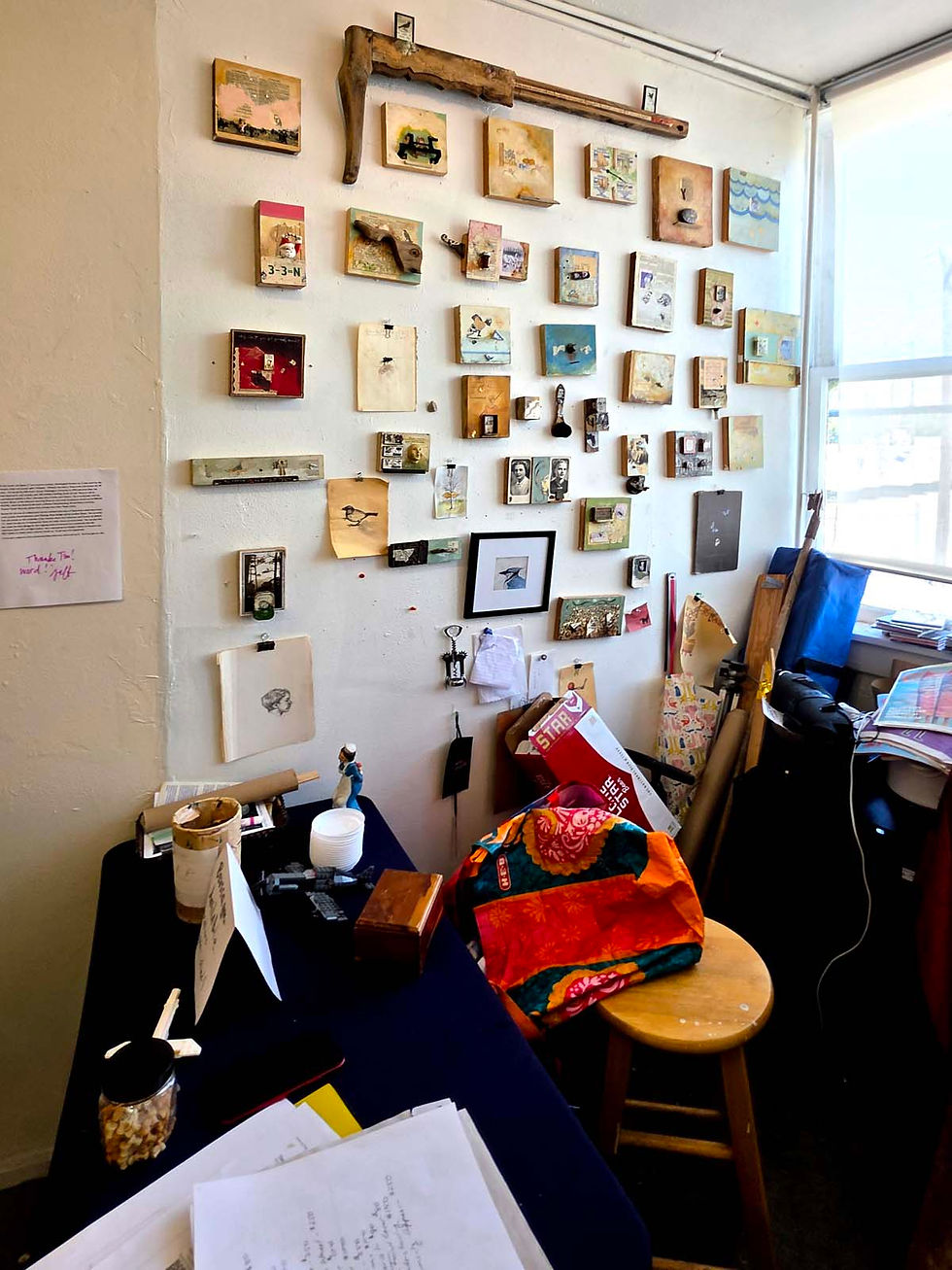

And there, almost surrounding the place where he works, were dozens of intimate little Olson constructions: drawings, photographs, scraps of old paper, pieces of wood, found objects, tiny boxes and inexplicable things rescued from wherever Tim finds inexplicable things. Some are barely larger than your hand. Others seem to have been assembled out of remnants somebody else would have thrown away.
Tim uses the space for his own exhibitions, but he also gives it over to other artists, alternating shows roughly every other month. He freely admits, with sufficient justification, that the schedule tends to lean a little toward Tim Olson. I'm not going to complain. He is one of my favorite artists I have encountered in years.
There is something absolutely genuine about both the work and the man making it. No branding strategy seems necessary. No explanation about an “artistic practice” is required before you can look at the objects. Tim makes things, collects things, notices things most of us walk past, and somehow rearranges them until they become worth looking at again.
There is another part of his Blue Star story that matters. He apparently had to wait quite a while before one of these small spaces became available. That fact may tell us as much about Blue Star as anything else in this story.
Because there is plenty of commerce here now. There are restaurants, apartments, shops, wine, beer and entertainment. Success inevitably puts pressure on the very character that made a place successful. Property becomes more valuable. Rents change. Audiences change. Restaurants attract more people than small galleries ever will. And artists begin wondering where they fit.
That tension isn't peculiar to Blue Star. It happens almost anywhere artists move into overlooked buildings and neighborhoods, make them interesting, and eventually attract the attention of everybody else. Whether Blue Star has moved too far toward commerce is probably not for Mission News to decide.
Walk around and decide for yourself. But before you do, climb the stairs, wander down one of those old industrial corridors and look through some of the smaller doors. Behind one of them you may still find an artist like Tim Olson, standing in a room he waited years to get, clearing the walls for somebody else's exhibition while his own little universe accumulates around his desk.
For the moment, the restaurants are still here. The developers are still here. And, more importantly, so are the artists. What happens next is the story.