


Arts Rescue Mission -Aid For Aging Artists


Vol. 2, No. 2, p. 3
April 10, 2026
P u b l i s h e d W e e k l y, N e w s, A r t s, & S t o r i e s F r o m T e x a s .... U s u a l l y
Jim Richard: Modern Fragments
Interiors, Collage, and the Theater of Taste
d. m. allison, April 10, 2026 (word count 1,128)
If Tommy Fitzpatrick builds architecture from the outside in, Jim Richard constructs his world from the inside out, through interiors, objects, and the quiet negotiations of taste that define how we live.
Richard has been working this territory for decades. Since the early 1990s, when he shifted from acrylic into oil, his work has consistently explored the push and pull between Modernism and its surroundings, between high art and the everyday environments that absorb, distort, and repurpose it. More recently, working in the velvety matte surface of Flashe vinyl paint, he has pushed that dialogue further, at times borrowing the visual logic of paint-by-numbers while placing it into spaces that feel both familiar and slightly off.
At the center of Richard’s work is the interior, not as a stable environment, but as a constructed stage. Into these spaces, he inserts images of sculpture, decorative objects, and fragments of art history, allowing them to coexist with domestic settings that feel at once real and edited.
In Modern Fragments at Inman Gallery, collage takes the lead. It’s a medium Richard has returned to consistently since the early 1990s, collecting printed material and recombining it into finished works, often as a daily studio exercise. By the late 1990s, collage had become integral to his practice, an efficient, intuitive counterpoint to the slower process of painting.
That practice deepened under pressure. During Hurricane Katrina in 2005, Richard evacuated New Orleans with a satchel of accumulated paper fragments and, while temporarily based in Austin, spent four months working on collages every day. The medium’s portability and immediacy became essential, both practically and psychologically, providing structure during a moment of disruption.
.
That sense of assembling stability from fragments still defines the work on view now at Inman in 2026.
Across these works, Jim Richard returns again and again to the interior—not as a fixed space, but as something constructed, tested, and quietly unsettled. Each composition begins with a recognizable environment, only to introduce elements that interrupt its logic, compress its depth, or pull it apart. What unfolds is less a series of discrete images than a sustained investigation into how space is built, and how easily it comes undone.
In Just Walkin (2023), that inquiry begins at the tabletop. A patterned cloth and scattered utensils establish a domestic setting, while a small figurative sculpture anchors the center. Behind it, foliage flattens into a decorative screen and a geometric border closes in at the edges. The scene feels staged, almost ceremonial, but the elements refuse to fully align. Fine dining, sculpture, and ornament coexist without resolving, producing a quiet dissonance. It is not one space so much as several, layered and slightly out of sync.
That instability carries forward into Passing Through (2022), where the setting shifts into a more architectural interior. A brick threshold opens onto a warmly lit room, but the passage is interrupted by irregular vertical forms, cut shapes that read as silhouettes or voids. These insertions fracture the continuity of the space, turning what might have been a straightforward interior into something more psychological. The viewer moves through it, but only provisionally, aware of the interruptions.
In Order (2022), the structure tightens but does not resolve. A modern living room—defined by clean lines, low furniture, and reflective surfaces—begins to cohere, only to be overtaken by large, flat planes of color. A red rectangle presses forward, joined by a vertical band of yellow and a cool blue-gray field. These elements compete with the image rather than support it. The title proposes stability, but the composition resists it. Order is introduced as an idea, then quietly undermined.
Earlier work such as Opening (2014) makes that disruption more explicit. A vivid yellow form spills across the interior, cutting through furniture, space, and perspective with a molten force. It reads less as an object
than as an event—something happening to the room rather than existing within it. The tension between the controlled environment and the uncontrolled gesture becomes central, setting the terms for what follows.
In Widespread III (2022), the interior gives way to a garden, but the underlying tension remains. Dense plantings draw the viewer inward, while a hovering geometric form—outlined in orange and filled with muted color—holds at the surface. Depth and flatness compete, each asserting a different version of space, neither fully yielding to the other.
By the time we arrive at Modern Fragments (2016), these concerns have been compressed into a tighter, more distilled form. Architectural elements, sculptural references, and planes of color are brought into close proximity, held in a composition that feels at once controlled and unresolved. Everything is present, but nothing holds.
(Click On Image To Expand To Full Screen)


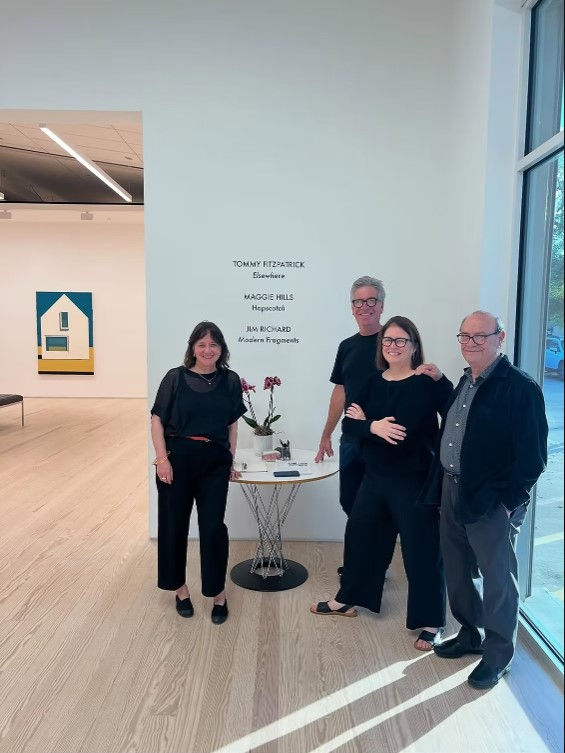
At the center of Richard’s work is the interior, not as a stable environment, but as a constructed stage. Into these spaces, he inserts images of sculpture, decorative objects, and fragments of art history, allowing them to coexist with domestic settings that feel at once real and edited.
Taken together, these works trace a consistent line of thought. Richard does not depict interiors so much as he constructs them, layering, interrupting, and recalibrating their logic until stability itself becomes provisional. Space, in his hands, is never given. It is assembled, tested, and left deliberately unresolved. Across these works, Richard’s compositional intelligence is unmistakable. He understands how to distribute visual weight, how to let one element stabilize a space while another unsettles it. The surfaces may appear casual, but they are carefully calibrated.
Richard Hamilton self portrait, 1960s
Richard Hamilton collage, 1960s
There’s a lineage here worth noting. His use of collage and interior space recalls Henri Matisse’s late cut-outs, where color and shape construct space as much as they describe it. At the same time, his layering of imagery and attention to everyday material echoes Robert Rauschenberg, particularly in the elevation of found visual language. And in the way interiors become sites of psychological and aesthetic tension, there are parallels to Richard Hamilton, whose work also examined domestic space as a reflection of cultural values.