


Arts Rescue Mission -Aid For Aging Artists


P u b l i s h e d W e e k l y, N e w s, A r t s, & S t o r i e s F r o m T e x a s .... U s u a l l y


Vol. 2, No. 2, p. 4
April 10, 2026
Maggie Hills, Hopscotch - Inman GalleryIntimacy, Memory, and the Wild Beasts
d. m. allison, April 10, 2026 (word count 778)
Maggie Hills’ paintings at Inman Gallery are small, but they don’t stay that way for long. They draw you in quickly, through color first, then structure, then image, until those distinctions begin to blur. What you are looking at starts to feel less observed than remembered, and that shift is where the work takes hold.
Hills builds her paintings from fragments, photographs, printed materials, personal images, and recurring visual motifs that move from one work to another. Forms reappear, bandstands, balconies, indistinct figures, faces that seem to surface and recede. The paintings carry the feeling of something sifted and reassembled over time. Not collage in any literal sense, even when the surface suggests it, but a painterly process of editing, layering, and distillation. Each work feels worked through, reduced to what matters and stripped of what does not. There is a strong sense of time embedded in these paintings, though not in any linear way. These are not moments captured; they are moments accumulated. Images feel as though they have passed through memory before arriving on the surface. They hover between presence and absence.
A figure is there, but not fully fixed. A space is suggested, but never fully described. Trees, interiors, and bodies drift in and out of legibility, as if the painting itself is searching for clarity. What becomes clear looking across these works is how strongly they relate to the legacy of Fauvism, literally “wild beasts,” particularly to Henri Matisse. This is not about influence in any academic sense, but about a shared freedom. Like the Fauves, Hills uses color as an expressive structure rather than a descriptive tool. Her blues, yellows, greens, and soft pinks are not bound to naturalism. They are chosen for how they hold the painting together, emotionally and compositionally.
You see it immediately in works like Fortune Tent, where a pale seated figure holds against vertical stripes that read like curtains or wallpaper, while dark marks and foliage move across the surface. Or in Park Lane Afternoon, where blocks of green, blue, and a warm peach organize the space more than any traditional sense of depth. These are constructed worlds, but they remain open, never fully resolved, never fully closed. There is also a difference from the Fauves that matters. Where Matisse and his contemporaries could be bold, even confrontational, Hills works on a quieter register. Her paintings are inward. They do not declare, they suggest. The color is alive, but it is held in check, tempered by a sensitivity to balance and restraint. The result is something more intimate, more psychological.
That matters because these paintings are not simply pleasing arrangements. They are psychologically charged. Betsy Huete, writing for Glass Tire for Hills’ exhibition at Bill’s Junk, Houston, Sept. 2019: Hills’ work is described at its strongest as operating less like assemblage and more like a kind of forensic analysis, distilling fragments into something precise and deliberate. That observation holds here. These paintings do not read as accumulations. They read as findings. Even when the surface suggests collage or fragmentation, the final image has been edited into something taut, controlled, and resolved.
That sense of control is what allows the work to remain open without becoming chaotic. There is always an underlying framework, grids that appear and dissolve, blocks of color that anchor the composition, passages that feel as though they have been “placed” rather than painted through. Motifs behave like images within images, as if each painting contains multiple spaces at once. And yet, for all of this structure, the work never becomes rigid. It remains fluid, suggestive, and at times quietly haunting. Figures appear as silhouettes or ghosts. Faces hover without fully declaring themselves. Landscapes shift into interiors and back again. The paintings hold onto something just beyond articulation.
(Click On Image To Expand To Full Screen)


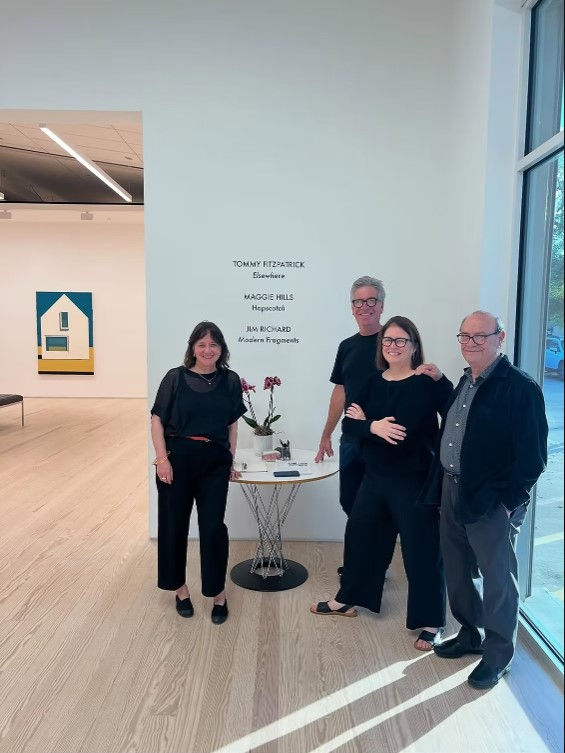
these paintings are not simply pleasing arrangements. They are psychologically charged. Betsy Huete, writing for Glass Tire for Hills’ exhibition at Bill’s Junk, Houston, Sept. 2019: Hills’ work is described at its strongest as operating less like assemblage and more like a kind of forensic analysis, distilling fragments into something precise and deliberate.
There is a strong sense of romance in that, romance not as sentiment, but as atmosphere. These are paintings that invite projection. They allow the viewer to meet them halfway, to bring their own associations into the work. Nothing is overexplained. Nothing is forced.
In the end, what Maggie Hills achieves here is a balance that is difficult to sustain: paintings that are both constructed and intuitive, structured and open, rooted in the history of painting yet entirely contemporary in feeling. The connection to Matisse and the Fauves is real, but it is transformed, pulled inward, made quieter, more reflective.
At Inman Gallery, these small paintings carry a surprising weight. They do not need scale to hold space. They ask only that you slow down, look closely, and allow them to unfold on their own terms.