


Arts Rescue Mission -Aid For Aging Artists


Vol. 2, No. 2, p. 5
April 11, 2026
P u b l i s h e d W e e k l y, N e w s, A r t s, & S t o r i e s F r o m T e x a s .... U s u a l l y
Mary Baxter, Random Moments from South Country
Mary Baxter: Painting the Edge of Memory
d. m. allison, April 11, 2026 (word count 1,527)
From the high desert of West Texas to the edge of memory, Mary Baxter paints not what the land looks like, but what it feels like to live inside it.
Born in Lubbock and raised in San Antonio, Baxter did not arrive at landscape as an academic subject. The connection began earlier, on family camping trips into the Chihuahuan Desert, where the scale of the land, the distance of the horizon, and the slow movement of weather imprint themselves before they are ever named. Those early experiences, wide sky, long distance, silence broken only by wind, are not recalled directly in her paintings, but they are embedded in them, structuring how space unfolds and how time is felt.
She studied painting and advanced printmaking at the University of Texas at San Antonio, graduating in 1987, financing her education through work on the high-goal polo circuit, a life already shaped by movement across terrain rather than distance from it. That detail matters. This is not the trajectory of someone moving toward landscape as an idea. It is someone already living within systems of land, motion, and weather before ever fully committing to paint.
By 1995, that trajectory settled into something more permanent when Baxter moved to a ranch southwest of Marfa, working with stocker yearlings and training horses. It was there, not in a classroom or studio, that the landscape began to shift from background to subject, or more precisely, from subject to condition. Ranch work does something specific to perception: it removes the romantic distance between viewer and land. You don’t look at weather; you depend on it. You don’t observe terrain; you move through it daily, repeatedly, until it stops being scenery and becomes structure.
After several years, Baxter transitioned fully into painting, spending a decade in Marathon where she converted the old Shoemaker Hardware building into a studio and gallery before returning to Marfa. Today, she divides her time between Marfa and a more remote ranch near Truth or Consequences, New Mexico, what her current body of work refers to as “South County.” That oscillation between two remote geographies deepens rather than divides the work. It gives her paintings a sense of continuity across distance, as if the land extends beyond any single location into a larger, shared atmosphere. That lived experience matters, because nothing in these paintings reads as observed from the outside. They do not feel composed after the fact. They feel remembered.
In the bull paintings, the animal stands in the foreground, heavy, dark, and still, but it is not the subject. The land itself glows with a saturated, almost mineral intensity, bands of orange and ochre laid down in broad, confident strokes that carry the memory of heat. The surface is not just painted; it is worked, built, and pushed until it holds a physical sense of dryness and light.
Above, the sky builds into something far more active. Clouds rise in dense, sculptural formations, then dissolve into softer passages of light and vapor, while beneath them distant rain falls in thin vertical veils that barely reach the horizon. The effect is not dramatic in a theatrical sense; it is cumulative. You feel the weather forming. You feel the distance it must travel. The bull is grounded; the weather is not. That tension, the fixed presence against a moving atmosphere, is what holds the painting together.
.
In the panoramic works, Baxter expands the scale outward, and the sky takes command.
In Comes a Frontal System, the clouds stack and turn, pressing downward until the land itself is compressed into a narrow band. The mountains remain, but they are held in place by the weight of what is forming above them. There is a quiet pressure in the painting, a sense that the atmosphere is not simply surrounding the land but actively shaping it.
In Pronghorn on the Plains, a small line of animals moves laterally across the middle ground, almost like a brief notation across the surface. They do not dominate the scene; they pass through it. That passing is essential. It introduces time, not narrative time, but duration. The land remains, the weather shifts, and life moves across it briefly, without altering its fundamental structure. What remains in both paintings is air, light moving through it, color shifting within it, weather gathering and dispersing in slow, continuous cycles. These are not landscapes in the traditional sense. They are paintings of conditions.
That sense of structure becomes even more apparent in works like Peak, where the land is brought forward and held in tension. The mountain is constructed in planes of color, warm reds and oranges catching light against cooler grays and violets, while the brushwork becomes directional and insistent, reinforcing the solidity of the form. The painting holds itself tightly, almost resisting dissolution.
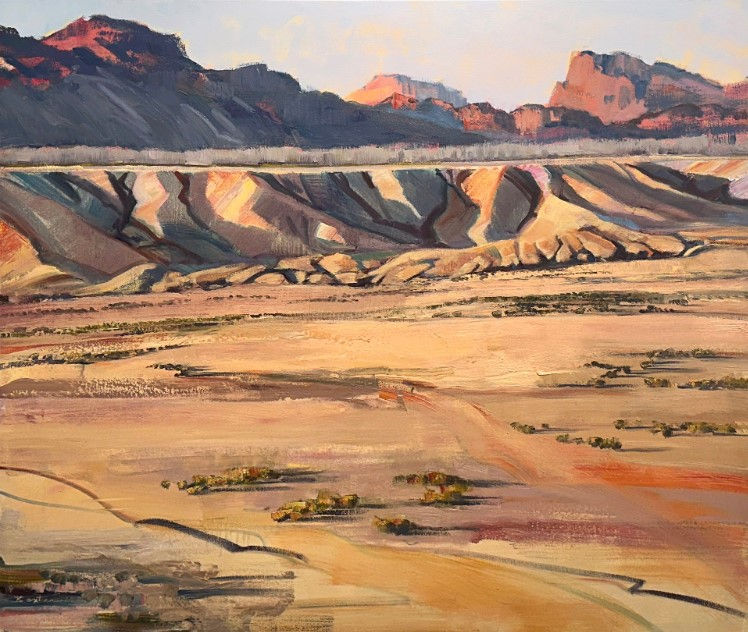
In Vast and Open, that tension dissolves. The land stretches outward in layered bands, sand, scrub, and distant ridges, each subtly shifting in tone, while the escarpment fractures into angular shapes and the far horizon softens into atmosphere. Here, space is not described so much as released. The painting breathes outward, allowing distance to reassert itself.
Baxter’s work is often described as expressionist, and that is true, but it is only part of the story.* Her paintings are grounded in the long tradition of artists who have tried to reconcile observation with experience, particularly in the American landscape.
There is a structural clarity in her compositions that recalls Milton Avery, where large fields of color organize the image more than detail ever could. Avery simplified the world into relationships, color against color, shape against shape, allowing the painting to function as a unified whole rather than a collection of parts. Baxter works in that same space, particularly in her skies, where clouds are not described but constructed as interlocking masses of color.
Within a Texas tradition, her work also finds a distant but meaningful connection to Porfirio Salinas. Salinas painted the Texas landscape with lyricism and clarity, often emphasizing seasonal change and regional identity. Baxter departs from that approach in a crucial way. Where Salinas offers a sense of place rooted in recognition and familiarity, Baxter strips away that narrative comfort. Her landscapes are not nostalgic; they are experiential. They do not ask to be remembered. They ask to be felt.
Her relationship to Rackstraw Downes is more structural than stylistic, but no less important. Downes is known for his extended horizontal compositions, particularly in Texas, where he records the land with an almost relentless clarity. His paintings insist on looking, on staying with the landscape long enough for its complexity to reveal itself. Baxter shares that commitment to the horizontal expanse, to the idea that the land must be experienced across distance rather than contained within a frame. But where Downes accumulates detail, Baxter distills it. She removes information until what remains is not description, but essence.
* Susie Tommaney, “Visual Arts Review: Mary Baxter Painting Far West Texas,” Houston Press, April 17, 2017.
(Click On Image To Expand To Full Screen)


these paintings are not simply pleasing arrangements. They are psychologically charged. Betsy Huete, writing for Glass Tire for Hills’ exhibition at Bill’s Junk, Houston, Sept. 2019: Hills’ work is described at its strongest as operating less like assemblage and more like a kind of forensic analysis, distilling fragments into something precise and deliberate.
What separates Baxter from all of these comparisons is not style, but immersion. This is not a painter visiting the land. This is a painter living within it, working ranches, watching weather patterns over years, moving between remote locations in a vintage trailer to gather studies en plein air before returning to the studio to build larger works from memory and accumulated experience.
That process matters because it introduces a gap between observation and execution. The paintings are not immediate responses to what is seen. They are filtered through time, through repetition, through memory. What remains is not the moment itself, but the residue of many moments layered together. The result is a body of work that does not describe the Southwest so much as embody it. Mountains, cattle, windmills, stock tanks, and shifting weather systems are all present, but none are privileged over the other. Each carries equal weight within the composition, contributing to a larger sense of balance and continuity. There is, as the gallery notes, a prevailing sense of serenity, but it is not passive. It is earned.
There is also restraint. Baxter knows when to stop. She allows areas of the painting to remain open, unresolved, so that space can continue to function rather than close in on itself. That restraint is what keeps the work from tipping into spectacle. Even at its most dramatic, towering clouds, distant rain, glowing ground, the paintings remain grounded in experience.
What becomes clear across this body of work is that Mary Baxter is not painting the land as it appears in a single moment. She is painting what remains after years of looking, the slow accumulation of weather, the compression of distance, and the way light moves across ground that does not change beneath a sky that never stops changing. In that sense, her work is not simply about landscape. It is about time.