


Arts Rescue Mission -Aid For Aging Artists

P u b l i s h e d W e e k l y, N e w s, A r t s, & S t o r i e s F r o m T e x a s .... U s u a l l y


Vol. 2, No. 2, p. 2
April 8, 2026
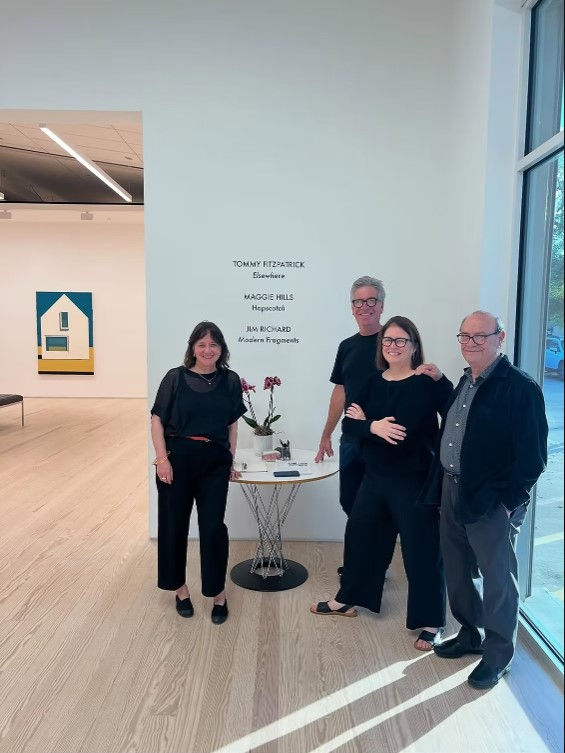
Tommy Fitzpatrick: Elsewhere, Inman Gallery
Building, Breaking, and Coming Home
d. m. allison, April 8, 2026 (word count 1,694)
For decades, architecture has been Tommy Fitzpatrick’s central subject matter, looking to the build environment as rich terrain to reflect the impermanence of human ambition. Elsewhere presents recent paintings in his latest ‘Dwellings’ series. Inspired by American vernacular architecture, his work explores the home as a built structure, a refuge and a shelter, through muscular paint application and sensitive color study.
Continually engaging the contradiction between flat pattern and illusionistic depth, Fitzpatrick uses architectural methods, tools, and materials in the studio to harmonize his process and subject matter. He begins by pouring acrylic paint onto the canvas – not unlike pouring cement – then using trowels and spatulas to shape, cut, and disrupt the congealed surface. Heavy-body acrylic polymers reinforce the paint’s structural integrity so that the paint itself protrudes in relief, creating peaks and divots that cast their own shadows and highlights. What may once have been roofs, windows, or glass now exist in an impasto ambiguity.
In years past, Fitzpatrick used computer-aided design (CAD) software as the foundation for his compositions. However, these latest ‘Dwellings’ embrace a more analog workflow through freehand drawings and color paper collages. For each painting, Fitzpatrick creates several color studies using Sherwin-Williams brand house-paint color samples before selecting one palette to develop into the final work. The nested rectangles, which are read as abstractions of windows or doorways, harken the legacy of Josef Albers’ Homage to the Square as generative color studies.
Streamlined and elemental, the works on view mark an important formal shift for the artist. While past work often depicted specific (and often renowned) buildings, the ‘Dwellings’ instead show a simple pitched roof, residential house. The image is familiar, nostalgic even, and meditative when viewed serially, one home after another. Grounded in their solitude, these homes prompt us to look inward, asking where do we belong?
Fitzpatrick writes: The home, as a built structure, is one of the most important places for humanity. It functions as refuge and shelter, a means of protection and survival. It is something people can universally understand, conjure, and project their own feelings and memories onto. Ultimately, these works are images of houses, but I hope the viewer feels invited to inhabit them, metaphorically entering the image as they would their own place of residence, or even the memory of one they once knew, into a space that carries the comfort of home.
Tommy Fitzpatrick (born 1969, Dallas, TX) works from models, either handmade and photographed or constructed digitally, to make his paintings, which hold a careful balance between abstraction and representation. Working from these models, he translates volume, perspective and light into hard-edged pattern, pairing a geometric articulation of space with an insistence on painted surface and careful attention to color. This contradiction between flat patterns and illusionistic depth is the terrain Fitzpatrick has been exploring with increasing sophistication for decades.
For more than three decades, Tommy Fitzpatrick has been working through one central idea: architecture, not just as structure, but as a record of human ambition, and just as importantly, its eventual unraveling.
From the beginning, Fitzpatrick’s work has lived in a space between abstraction and representation. You might recognize a fragment, a roofline, a beam, a pane of glass, but it never settles into something fully descriptive. Instead, forms tilt, intersect, and fracture into a visual language that feels constructed rather than observed. His paintings don’t depict buildings so much as they rebuild them, piece by piece, from memory, speculation, and process.
Early on, Fitzpatrick worked from tightly cropped photographs of architectural spaces, pulling out sharp angles and compressing them into dense compositions. But even then, there was a kind of resistance to simply representing what was there. He has said, half-jokingly, that “if there’s no roof, there’s no painting,” but the deeper question he was circling was how far he could push an image before it stopped being architecture and became something else entirely.
That question led to a turning point around the mid-2010s. Instead of relying solely on photographs, Fitzpatrick began building small sculptures in the studio, temporary constructions that were never meant to be shown. These objects had weight, balance, and physical presence. They obeyed gravity. They cast shadows. He would photograph them obsessively, sometimes producing thousands of images, then slice those images apart and recombine them into a single composition.
What resulted was a kind of controlled instability. Multiple viewpoints collapse into one surface. Structures appear to shift as you look at them, like something caught mid-construction, or mid-collapse. Fitzpatrick once likened this process to a “string game,” a fleeting configuration that only holds together for a moment before it changes form. The paintings carry that tension. They feel precise, even engineered, but never entirely secure.
By the time of his 2017 exhibition Crystal Cities, that tension had expanded into a broader conceptual framework. Drawing inspiration from Frank Lloyd Wright’s unrealized utopian project of the same name, Fitzpatrick turned his attention to architecture that never existed, designs that were imagined but never built.
That shift matters. Instead of responding to the physical world, he was now working with ideas, proposals, ambitions, futures that didn’t happen. The paintings from that period suggest fragments of a larger system: towers, corridors, structural grids, all rendered with crisp precision but suspended in uncertain space. They feel like artifacts from a future that never arrived, or ruins of a plan that was abandoned halfway through.
There’s a deep engagement here with modernism, not just its visual language, but its belief that architecture could shape society. You can feel echoes of Bauhaus and Constructivist thinking in the way his forms interlock and extend beyond the frame. But Fitzpatrick isn’t celebrating those ideals so much as examining what happens when they break down. What remains is not a coherent system, but a field of fragments, what one writer described as a kind of “fallen utopia.”
Materially, the work reinforces that idea. Fitzpatrick doesn’t just paint surfaces, he builds them. Acrylic paint is poured onto the canvas almost like concrete, then pushed, cut, and shaped using tools you’d expect to find on a construction site. The result is a surface that physically protrudes, with ridges and planes that cast their own shadows.
These aren’t illusions of depth, they are depth. The painting becomes an object, somewhere between image and structure.
At one point, Fitzpatrick even incorporated digital tools into his process, using CAD software to generate compositions before translating them into paint. It was a natural extension of his architectural thinking, constructing a space before building it physically. But even there, the interest wasn’t in precision for its own sake. It was in the gap between the idea and the object, between what is imagined and what is realized.
Throughout all of this, one theme keeps resurfacing: impermanence. Buildings rise and fall. Styles come and go. What was once visionary becomes obsolete. Fitzpatrick’s paintings capture that cycle, not as narrative, but as condition. His structures feel both solid and temporary, as if they could shift or disappear at any moment.
Which is what making the work in Elsewhere, his current exhibition at Inman Gallery, such an interesting turn.
After decades of working with architecture as a public, often monumental language, Fitzpatrick has shifted his focus to something much more familiar: the house. At first glance, the change feels almost disarming. Gone are the sprawling, interlocking systems and speculative cityscapes. In their place are simple, pitched-roof structures, images that read immediately as homes. But the shift isn’t a retreat. It’s a distillation.
The house is architecture at its most basic, most universal level. It’s something everyone recognizes, but it’s also something we projects onto. Memory, comfort, isolation, identity, they all live there.
Fitzpatrick leans into that ambiguity. These are not specific houses. They don’t belong to a particular place or time. They exist somewhere between recognition and abstraction, inviting the viewer to fill in the rest.
Formally, the work has become more streamlined. The compositions are cleaner, more contained. Where earlier paintings were dense and expansive, these feel focused, even meditative.
(Click On Image To Expand To Full Screen)


That question led to a turning point around the mid-2010s. Instead of relying solely on photographs, Fitzpatrick began building small sculptures in the studio, temporary constructions that were never meant to be shown. These objects had weight, balance, and physical presence. They obeyed gravity. They cast shadows. He would photograph them obsessively, sometimes producing thousands of images, then slice those images apart and recombine them into a single composition.
Repeated shapes, rectangles suggesting windows or doors, create a rhythm across the surface. There’s a quiet dialogue here with Josef Albers, especially in the way color is used to structure space rather than describe it.
That said, the underlying tensions haven’t gone anywhere. Fitzpatrick is still working between flatness and depth, between image and object. The paint still carries weight. It’s poured, cut, and shaped, creating surfaces that rise off the canvas and catch the light. But there’s a noticeable shift in how the work is made.
Where earlier paintings often relied on digital models or complex photographic processes, the Dwellings move back toward something more direct. Freehand drawing, paper collage, and hands-on color studies replace CAD renderings. Fitzpatrick has even used house-paint samples, Sherwin-Williams chips, to build his palettes, grounding the work in the everyday materials of domestic space.
It’s a subtle but meaningful change. The process becomes more immediate, more tactile, more in line with the subject itself.
And the effect of that shift is a kind of quieting. The drama of fragmentation is still there, but it’s been softened. Instead of structures breaking apart, we’re looking at forms that hold together, barely, maybe, but enough. The repetition of the house image creates a rhythm that feels almost contemplative, like returning to the same thought from slightly different angles.
If Fitzpatrick’s earlier work asked how we build the world, and what happens when those systems fail, Elsewhere asks something closer to home.
Where do we belong within all of this? It’s a question that doesn’t resolve, and the paintings don’t try to answer it. Instead, they offer a space to sit with it, to move through these constructed images the way you might move through memory itself, recognizing something familiar without ever fully pinning it down.
And in that sense, the work feels less like a departure than a return. Not to a specific place, but to a more fundamental idea: that architecture, at its core, is not just about structures. It’s about the human need to build, to inhabit, and to find meaning in the spaces we create.