Arts Rescue Mission -Aid For Aging Artists

P u b l i s h e d W e e k l y, N e w s, A r t s, & S t o r i e s F r o m T e x a s


Vol. 1, Issue 7, P. 2
Dec. 22, 2025
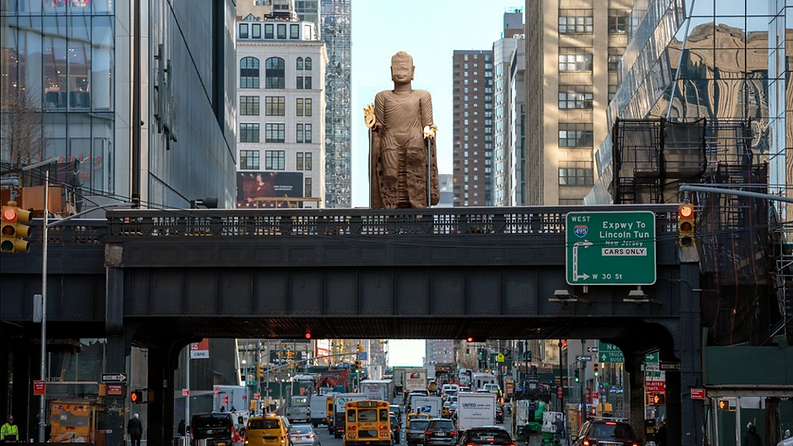
Tuan Andrew Nguyen on the High Line, New York, ARM Reporting December 18, 2025
(word count 562)
When Tuan Andrew Nguyen was commissioned by High Line Art, the result was never going to be a conventional public artwork. Nguyen’s practice, shaped by histories of Vietnam, diasporic memory, and the long shadows of colonialism and war, has always resisted easy legibility. Installed along the High Line, his work enters into dialogue not only with contemporary audiences, but with the site itself: a former industrial artery transformed into one of the most visible cultural spaces in the city.
Nguyen’s installation continues themes developed across his film, sculpture, and collaborative projects, many of which are documented through The Propeller Group, the artist collective he co, founded in Ho Chi Minh City. As noted in materials published by High Line Art and in interviews conducted with institutions such as MoMA PS1, Nguyen is less interested in delivering historical facts than in exploring how history is felt, misremembered, and transmitted across generations.
On the High Line, this sensibility translates into an artwork that refuses monumentality. Rather than dominating the skyline or competing with the spectacle of Manhattan, Nguyen’s piece operates through restraint. Viewers encounter it while walking, talking, scrolling, or simply passing time, often without realizing they are stepping into a meditation on loss, displacement, and survival. This approach aligns with Nguyen’s broader philosophy, articulated in essays and interviews published by outlets such as Artforum, Frieze, and e, flux, where he describes art as a space for “listening rather than declaring.”
The High Line itself plays a critical role in this exchange. As documented by Friends of the High Line, the park occupies a layered historical terrain: once a utilitarian rail line, later abandoned, now celebrated as a symbol of urban renewal. Nguyen’s work subtly complicates that narrative. Without directly referencing Vietnam or the United States by name, it gestures toward histories that do not resolve neatly into progress stories. What is gained when cities are rebuilt, and what, or who, is left behind?
Because High Line Art commissions are encountered by a public that did not necessarily choose to see art, Nguyen’s installation benefits from friction. Tourists, office workers, artists, and families meet the work unexpectedly. This echoes Nguyen’s use of “found audiences” in previous projects, including film works exhibited at Venice Biennale and Guggenheim Museum, where he has represented Vietnam and participated in major thematic exhibitions.
What ultimately distinguishes Nguyen’s High Line project is its emotional temperature. It does not instruct viewers what to think. Instead, it creates a pause, an invitation to reflect amid the movement of the city. In a public art landscape often dominated by scale, branding, and spectacle, Nguyen offers something rarer: an acknowledgment of unresolved histories and quiet endurance.
(Click On Image To Expand To Full Screen)
Seen through the lens of High Line Art’s mission to commission works that respond to place, Nguyen’s installation succeeds precisely because it does not resolve the site’s contradictions. It inhabits them. Suspended above the streets, the work becomes a reminder that beneath every celebrated surface lies a deeper, more complicated story, one that continues to unfold as long as someone is willing to stop, look, and listen.
Sources consulted and referenced:
High Line Art commission texts and curatorial statements; artist interviews published by Artforum, Frieze, and e, flux; institutional materials from MoMA PS1 and The Propeller Group; Friends of the High Line historical documentation.
When Tuan Andrew Nguyen was commissioned by High Line Art, the result was never going to be a conventional public artwork. Nguyen’s practice, shaped by histories of Vietnam, diasporic memory, and the long shadows of colonialism and war, has always resisted easy legibility. Installed along the High Line, his work enters into dialogue not only with contemporary audiences, but with the site itself: a former industrial artery transformed into one of the most visible cultural spaces in the city.